Terry Pratchett City Watch Series Reading Order
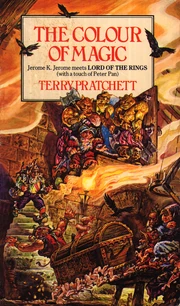
Embrace of an early edition of The Colour of Magic; art by Josh Kirby
Discworld is a comedic fantasy book serial by the British writer Terry Pratchett, ready on the Discworld, a flat world balanced on the backs of four elephants which, in turn, stand on the back of a giant turtle, Slap-up A'Tuin. The books frequently parody, or at least borrow ideas from, J. R. R. Tolkien, Robert E. Howard, H. P. Lovecraft and William Shakespeare, too as mythology, folklore and fairy tales, often using them for satirical parallels with current cultural, technological and scientific problems.
Since the first novel, The Colour of Magic (1983), the series has expanded, spawning several related books and maps, four short stories, cartoon, theatre adaptations, estimator games, and music inspired by the serial. The first alive-action screen adaptation for television (Terry Pratchett's Hogfather) was broadcast over Christmas 2006. A second, ii-part TV adaptation of The Colour of Magic was circulate in March 2008 in the United kingdom.
Newly released Discworld books regularly elevation The Sunday Times best-sellers list, making Pratchett the Britain's best-selling writer in the 1990s, although he has since been overtaken past Harry Potter author J.Yard. Rowling. Discworld novels accept also won awards such every bit the Prometheus Award and the Carnegie Medal. In the BBC's Big Read, five Discworld books were in the top 100, and a full of fifteen in the top 200.
Contents
- 1 Writings
- 1.i Rincewind
- 1.ii Death
- 1.3 The Witches
- ane.four The City Lookout
- 1.5 The Wizards
- one.6 Tiffany Aching
- 1.seven Moist von Lipwig
- one.eight The History Monks
- ii Reading orders
- three Themes
- 3.1 Villains
- 3.1.ane Elves and auditors
- three.1.two Humans
- 3.2 Heroes
- iii.three Lodge
- 3.1 Villains
- 4 Bibliography
- 4.one Novels
- 4.ii The Mapps
- 4.3 Science books
- 4.4 Quiz books
- iv.v Diaries
- 4.6 Other books
- v Adaptations
- half dozen Merchandise
- vi.one Music
- six.ii Games
- 7 Come across besides
- 8 References
- 9 External links
- 10 Characters, locations, etc
Writings [ ]
Equally of 2015, at that place take been 41 Discworld novels published, five of which are marketed as children's or "immature adult" (YA) books. The original British editions of the first 26 novels, up to Thief of Time (2001), had distinctive comprehend art past Josh Kirby; the American editions, published by HarperCollins, used their ain cover fine art. Since Kirby's death in October 2001, the covers have been designed by Paul Kidby. Recent British editions of Pratchett's older novels no longer reuse Kirby's art. There have also been six short stories (some merely loosely related to the Discworld), 3 pop science books, and a number of supplementary books and reference guides.
Very few of the Discworld novels have chapter divisions, instead featuring interweaving story-lines. Pratchett is quoted every bit maxim that he "only never got into the habit of chapters", after adding that "I accept to shove them in the putative YA books because my editor screams until I exercise". However, the commencement Discworld novel, The Colour of Magic, was divided into "books", as is Pyramids. Additionally, Going Postal and Making Money do indeed have chapters, prologue, epilogue, and brief teasers of what is to come in each chapter, in the style of A. A. Milne, Jules Verne and Jerome K. Jerome.
To a greater or lesser caste, Discworld stories stand alone as contained works gear up in the same fantasy universe. However, a number of novels and stories can exist grouped together into grand story arcs dealing with a set number of characters and events. The master threads within the Discworld serial are:
Rincewind [ ]
Rincewind was the first Discworld "hero"; a wizard with no skill, no training and no interest in heroics. Nonetheless, he is constantly thrust into adventures that accept him from i end of the Discworld to the other, much against his will. His stories mainly serve to reveal the geography of the Disc to the reader, since Rincewind's stories take him into far and exotic locations. Other characters in the Rincewind story arc include Cohen the Barbaric, an crumbling hero of the quondam fantasy tradition out of touch with the modernistic world, Twoflower, a naive tourist from the Agatean Empire (the Discworld's equivalent of Mainland china) and The Luggage, a semi-sentient and exceptionally vicious travelling example. Rincewind has appeared in half dozen Discworld novels, as well as the three Science of Discworld supplementary books. Cohen the Barbarian besides appears in the brusque story, Troll Bridge.
Death [ ]
Expiry is the closest thing the Discworld series has to a chief character (in that he appears in nigh every volume; however, sometimes he has no more than a few lines). He has appeared in every novel except The Wee Free Men, sometimes in a cameo, sometimes equally the chief protagonist. Equally dictated by tradition, he is a seven-pes-tall skeleton with a black robe and a scythe who sits astride a pale equus caballus (called Binky). The anthropomorphic personification of death, his job is to guide souls onward from this world into the side by side. Over millennia in the role, Death has developed a fascination with humanity, fifty-fifty going then far as to create a house for himself in his personal pocket dimension. Characters that often appear with Death include his "butler" Albert; his "granddaughter" Susan Sto Helit; the Death of Rats, a mini-version of Death in charge of gathering the souls of rodents; Quoth, a talking raven(a parody of The Raven); and the Auditors of Reality, personifications of the orderly laws of nature, who have declared state of war on life itself, believing that it is "messy". Since Death cannot exist without life, he finds himself taking its side confronting the machinations of the Auditors. Death or Susan announced equally the master characters in five Discworld novels. He likewise appears in the short stories Death and What Comes Next, Theatre of Cruelty and Turntables of the Night .
The Witches [ ]
Witches in Pratchett's universe are largely stripped of their mod occultist, Wiccan associations (though Pratchett does frequently use his stories to lampoon such naive conceptions of witchcraft), and act more in their traditional role equally herbalists, ajudicators and wise women. That is non to say that witches on the Disc cannot utilize magic; they just prefer not to, finding simple psychology is often far more than effective. The master witch in the series is Granny Weatherwax, a taciturn, bitter old crone from the small mountain country of Lancre. She largely despises people but takes on the role of their healer and protector because no one else tin do the job likewise as she tin. Her closest friend is Nanny Ogg, a jolly, personable witch with the "common touch" who enjoys a fume and a pint of beer. The ii have on apprentice witches, initially Magrat Garlick, then Agnes Nitt, and then Tiffany Aching, who in turn grow on to go accomplished witches in their own right, or, in Magrat's instance, Queen of Lancre. Other characters in the Witches serial include King Verence II of Lancre, a onetime jester who as a result takes his job every bit king very seriously, Jason Ogg, Nanny Ogg's eldest son and local blacksmith (and also, like the smiths of sometime, something of a magician himself), Shawn Ogg, Nanny'south youngest son who serves every bit his country's entire regular army, and Nanny's murderous cat Greebo. The witches have appeared in numerous Discworld books, but accept featured as master protagonists in seven. They accept also appeared in the short story, The Sea and Little Fishes. Their stories frequently draw on ancient European folklore and fairy tales, and also parody famous works of literature, particularly by Shakespeare.
The Urban center Scout [ ]
The stories featuring the Ankh-Morpork City Watch are urban-set, and ofttimes show the clashes that result when a traditional, magically run fantasy world such as the Disc comes into contact with modern applied science and culture. They centre around the growth of the Ankh-Morpork City Picket from a hopeless gang of three to a modern, fully equipped and efficient police forcefulness. The stories are largely police procedurals, featuring a mystery that frequently has political or societal overtones. The master character is Sam Vimes (later His Grace, Sir Samuel Vimes), a haggard, contemptuous street copper who finds himself swept up in history as his inept cadre of law enforcement officials (comprising petty thief Nobby Nobbs and perennially lazy Sargeant Colon) grows and takes on new recruits, particularly from the Disc'due south "minority groups", such as dwarfs, trolls, and the undead. Other main characters include Carrot Ironfoundersson, the rightful heir to the throne of Ankh-Morpork, who thus has a traditional hero's destiny thrust upon him but chooses to ignore information technology; his girlfriend Angua, a werewolf; Detritus, a troll; Cheery Littlebottom, the Watch's forensics proficient who is ane of the outset dwarfs to exist openly female; Sam's married woman, Lady Sybil Vimes; and his boss, Havelock Vetinari, the alternately Machiavellian/chivalrous Patrician of Ankh-Morpork. The City Watch have starred in eight Discworld stories, and have cameoed in a number of others, including the children'due south book, Where's My Cow? and the brusk story Theatre of Cruelty.
The Wizards [ ]
The Wizards of the Unseen University have represented a strong thread through many of the Discworld novels, although the only books that they star in exclusively are the "Science of the Discworld" serial. In the early books, the faculty of the UU changed oftentimes, as ascension to the top unremarkably involved assassination. Still, with the ascension of the bombastic Mustrum Ridcully to the position of Archchancellor, the hierarchy has settled and characters accept been given the chance to develop. The before books featuring the wizards likewise oft dealt with the possible invasion of the Discworld past the creatures from the Dungeon Dimensions, Lovecraftian monsters that hunger for the magic and potential of the Discworld. The wizards of the UU utilize the traditional "whizz-bang" type of magic seen in Dungeons & Dragons games, simply also investigate the rules and structure of magic in terms highly reminiscent of particle physics. Prominent members include Ponder Stibbons, a geeky immature wizard who, unlike the rest of the staff, actually wants to larn most the universe, Hex, the Disc'southward first supercomputer, the Librarian, who was turned into an orangutan by magical accident early in the series and shows no want to be turned back, and the Bursar, the clinically insane savant who crunches the UU's numbers and subsists on a nutrition of his own nerves and dried frog pills. In afterward novels, Rincewind also joins their group. The Wizards accept featured prominently in 8 Discworld books and accept also starred in the Science of Discworld series and the short story, A Collegiate Casting-Out of Devilish Devices.
Tiffany Agonized [ ]
Tiffany Agonized is a young apprentice witch and star of a series of Discworld books aimed at young adults. Her stories often parallel mythic heroes' quests, but also deal with Tiffany'south difficulties every bit a young girl maturing into a responsible woman. She is aided in her chore by the Nac Mac Feegle, a gang of difficult-drinking, loudmouthed pictsie creatures who serve as her guardians. Both Granny Weatherwax and Nanny Ogg have also appeared in her stories. She has appeared in five novels, the fifth 1 published posthumously.
Moist von Lipwig [ ]
Moist von Lipwig is a professional criminal and con human to whom Havelock Vetinari gives a "second chance" after staging his execution, recognising the advantages his jack-of-all-trades abilities would take to the development of the city. After setting him in charge of the Ankh-Morpork Mail Office, to practiced issue, Vetinari ordered him to clear upwardly the metropolis's corrupt financial sector, to which he rather ironically acquitted himself well. A third book, in which Lipwig is ordered to organise the city'due south taxation system, is planned. Other characters in this series include Adora Belle Dearheart, Lipwig's acerbic, concatenation-smoking lover, Gladys, a golem who develops a strange crush on Lipwig, and Stanley Howler, a mildly autistic swain who becomes the Disc'due south first stamp collector.
The History Monks [ ]
The History Monks are a group of vaguely Buddhist-like monks who have taken on the job of ensuring that history passes smoothly. In that sense, as Pratchett says, they straddle the boundary betwixt human beings and personifications. They perform their task in 2 means: first, their monastery is home to the History Books; 20,000 x-foot long, lead-spring volumes that record every event of historical relevance as it occurs. Second, they manage and command the flow of fourth dimension, much similar a public utility. Whenever the orderly flow of time gets disrupted (if, say someone is sent back into the past), the History Monks ship agents into the field to repair the damage as best as possible. The principal History Monk in the novels is Lu-Tze, nominally the monastery's sweeper but in fact i of the highest ranking monks in the organisation. The History Monks have appeared in 3 Discworld novels to date.
Reading orders [ ]
Reading social club is not restricted to publication club; withal, each arc may be best read chronologically. Some master characters may brand cameo appearances in other books where they are not the primary focus; for example, Carrot Ironfoundersson and Angua von Überwald appear briefly in Going Postal. The books take place roughly in existent-time and the characters' ages change to reflect the passing of years. No distinction will ever exist lucent. Many stories (such as The Truth and Monstrous Regiment) nominally stand alone but, nonetheless, necktie in heavily with main story-lines. A number of characters, such equally members of staff of the Unseen University, Lord Vetinari and the Elves, announced prominently in many dissimilar story-lines without having titles of their own. As information technology is, many of these "standalone" stories deal with the development of the city of Ankh-Morpork into a technologically and magically advanced metropolis that readers volition find analogous to real-earth cities: for example, The Truth catalogues the rise of a newspaper service for the city, the Ankh-Morpork Times, and Going Postal similarly deals with the development of a postal service and the rise of the Discworld'southward telecommunications system, called "the clacks".
Themes [ ]
Villains [ ]
Discworld has a relative lack of recurring or overarching villains. Many of Pratchett's potential villains, such as Lord Vetinari and Lord Downey, are too complex or multifaceted to exist simplistically characterised every bit "evil", while other more standard villains, such as Lord Rust, are depicted merely as egoistic dullards. Principal villains in Discworld novels tend to die or be put similarly out of action by the story's cease. The Lovecraftian creatures from the Dungeon Dimensions cannot exist considered evil in the traditional sense, since they are utterly amoral.
Elves and auditors [ ]
There are, however, two groups of villains that feature prominently in many of the stories and have, in their own ways, come up to stand for the force of 'wrongness' in the Discworld: the Auditors of Reality and the Elves.
The Auditors, cosmic bureaucrats who adopt a universe where electrons spin, rocks bladder in space and imagination is dead, represent the perils of handing yourself over to a completely materialist and deterministic vision of reality, devoid of the myths and stories that brand the states homo. The Elves, innately psychopathic beings who seek to dominate people by usurping their free will with glamour and imitation magic, represent the dangers of giving yourself over completely to stories and superstition.
Together they announced to reflect the philosophy Pratchett expresses in Hogfather and is a recurring theme throughout the series; that while the stories we weave may not be truthful, nosotros still need them to continue our beingness. Nonetheless, it would be wrong to categorise the Auditors or Elves but as 'evil'. While their actions crusade misery, it is only incidental. Elves do not sympathise the suffering they cause every bit they have no empathy, while the Auditors are simply a form of supernatural bureaucrat who think humans cause too much inefficiency.
Humans [ ]
His adept witch, Granny Weatherwax, takes the class of an archetypical evil crone:
- Mrs Earwig would definitely take objected to the cottage. Information technology was out of storybook. The walls leaned against one another for support, the thatched roof was slipping off similar a bad wig, and the chimneys were corkscrewed. If you thought a gingerbread house would be also fattening, this was the next worst thing.
- "In a cottage deep in the forest lived the wicked old witch ..."
- It was a cottage out of the nastier kind of fairy tale.
- – A Hat Total of Sky
His good public servant, Lord Havelock Vetinari, is an assassinator and a tyrant, but acting in his city'due south best interests as a benevolent dictator nevertheless. It is speculated that he is based on one of the Medici rulers of Renaissance Florence, or perhaps Machiavelli.
In general, Pratchett presents the notion that to be good quite ofttimes results in being perceived equally bad or evil by the very people you're doing good for, and in many of his stories paradigm is somewhen overcome, without fanfare, past substance.
- , said Decease.
- – Hogfather
In the Elf books, as elsewhere, he presents the notion that our "world" is subjective, and is constructed internally. In particular, that it is synthetic out of stories. Related to this is the idea that nigh of our feel is filtered out before it reaches consciousness:
- You build lilliputian worlds, little stories, little shells around your mind and that keeps infinity at bay and allows you lot to wake upwardly in the forenoon without screaming!
- – A Lid Full of Sky
- "All correct," said Susan, "I'thou not stupid. You're saying humans need ... fantasies to make life bearable."
- "Tooth fairies? Hogfathers?"
- "So nosotros can believe the big ones?"
- "They're non the same at all!"
- "Yes. But people accept got to believe that or what's the point — "
- – Hogfather
Also in the Elf books, Pratchett presents elves as nasty, evil creatures. This follows original English folk songs and stories e.g. Tam Lin, quite in contrast with how they were portrayed by Tolkien which is more ordinarily known these days.
- Elves are wonderful. They provoke wonder.
- Elves are marvellous. They cause marvels.
- Elves are fantastic. They create fantasies.
- Elves are glamorous. They project glamour.
- Elves are enchanting. They weave enchantment.
- Elves are terrific. They beget terror.
- The thing virtually words is that meanings can twist just similar a snake, and if yous desire to find snakes await for them behind words that accept changed their meaning.
- Nobody said elves were dainty.
- Elves are bad.
- – Lords and Ladies
A large portion of Carpe Jugulum is about "internal struggles", and how pieces of our listen practise non ever agree with other pieces of our mind (and how some of us experience we have "Darker" selves within usa, that we keep deep, deep down). Aside from the obviously "split" mind character (Perdita and Agnes, Good Oats and Bad Oats), it is shown that even characters equally decisive as Granny Weatherwax have inner "selves" with whom they struggle.
While central human villains do not recur from novel to novel, the individuals often share certain personality traits. The about prominent of these traits is the lack of the aforementioned "internal struggle". They are villains not because their bad self has won the struggle, but because they never had a conception of expert and bad in the offset identify. This results in a person who is completely dispassionate, egoistic, and lacking virtually recognizable human emotions. This is very like to the character of the elves, but portrayed in a more than negative light, since such characteristics are inherent in elves equally a species, while the reason for a human to act in such a manner is less clear cutting. These amoral human villains are ofttimes highly intelligent and develop schemes to shape society or the earth to adjust to their views of how things should work. While the description may not apply to every cardinal villain, many of them could be described as sociopaths. Examples include Vorbis (Pocket-size Gods) and Mr Teatime (Hogfather). In the book "Night Picket" Commander Vimes considers that the volume's villain, Carcer, is not a madman just is actually dangerously sane, having realised that the laws and conventions most people follow don't have to apply to him if he doesn't want them to.
The concept of racial hatred is touched upon oft when Trolls and Dwarves are nowadays and forms a significant plot pillar in Thud!, in which the most ardent proponents of racial hatred are the clear villains. The problems of racial integration, multiculturalism, and racial hatred are also a topic of "Jingo", which also echoes the long held divisions and superstitions between rival great powers in this earth, such as U.S. and USSR, using the metaphor of "two large men in a small-scale room".
Heroes [ ]
In several books, characters or narration bring upwardly the question of precisely what constitutes a "hero" and whether in that location'south annihilation actually "heroic" about gung-ho violence.
This is generally the ground for Cohen the Barbarian and the actions of his Silvery Horde, equally shown in The Final Hero, in which the Patrician points out that when people say that heroes defeat tyrants, steal things from the gods, seduce women and kill monsters, they are, in fact, proverb, that heroes murder, steal, rape, and wipe out endangered species. Lord Vetinari also asks the question, "When a tyrant is defeated or a monster killed, who is the person defining the monstrousness of the monster, or the tyranny of the tyrant? The hero. In fact, when a hero kills someone, he is in fact saying that, if you take been killed past a hero, so you are a person who is suitable to be killed past a hero."
Many Discworld stories feature Rincewind, a dour and sick-fated wizard who specializes in the art of the escape. Whatsoever 'heroic' deportment on Rincewind'due south part are, for the most office, caused past accident or sheer bad luck, which often puts him straight back into the very state of affairs he was running from in the first place. Rincewind is categorically not a 'hero' in the traditional sense, since he simply wants to be left alone. Many Discworld protagonists share this trait, such equally Moving Pictures' Victor Tugelbend and The Truth'south William de Worde.
In particular, The Fifth Elephant raises the signal of view that if someone can kill a villain and and so joke about it, they are no less a murderer than the villain himself. This idea is had by Commander Vimes, who really considers several possible "quips" after tricking the villain to his decease, merely declines to say them out loud, raising the prospect (dealt with at greater length in Night Watch, amid many other books) that the most effective heroes are natural villains who cull to act in accord with a particular system of ethics.
Guild [ ]
Many concepts of regime and types of social systems appear in Discworld:
- Does the social contract extend to feeding virgins to dragons?
- Is law-breaking best addressed by legalizing it, regulating information technology, and allowing thieves and assassins to control theft and murder?
- Do revolutions finish upward replacing 1 tyrant with another?
- Is democracy just a choice amid tyrants?
- Does organized religion destroy belief in the supernatural?
- Does insurance simply increase property damage?
Bibliography [ ]
Novels [ ]
| Nº | Name | Published | Grouping | Notes | Motifs |
|---|---|---|---|---|---|
| 1 | The Colour of Magic | 1983 | Rincewind | Came 93rd in the Big Read. | Fantasy clichés, H. P. Lovecraft, tourism, insurance, Dungeons & Dragons |
| ii | The Calorie-free Fantastic | 1986 | Rincewind | Tourism, apocalypse, Conan the Barbarian | |
| iii | Equal Rites | 1987 | The Witches | Gender equality, Ursula K. Le Guin's Earthsea trilogy | |
| 4 | Mort | 1987 | Death | Came 65th in the Big Read | Death and its personification, apprenticeship |
| 5 | Sourcery | 1988 | Rincewind, The Wizards | Apocalypse, Kubla Khan , Aladdin , Arabian Nights | |
| vi | Wyrd Sisters | 1988 | The Witches | Came 135th in the Big Read | Shakespeare (peculiarly Macbeth and Hamlet), Sleeping Beauty |
| vii | Pyramids | 1989 | Miscellaneous | Egyptian mythology, quantum physics, Greek philosophy (including Zeno's paradoxes), United Kingdom driving test | |
| viii | Guards! Guards! | 1989 | The Metropolis Watch | Came 69th in the Big Read | Cop novels, show dogs, dragons, fraternal organisations, aristocracy, clandestine societies |
| 9 | | 1990 | Rincewind | Start published 1990 in a larger format, fully illustrated by Josh Kirby; reissued as a paperback without illustrations. | Faust, Dante's Inferno , Homer's Iliad |
| ten | Moving Pictures | 1990 | Miscellaneous, The Wizards | Hollywood (especially silent movies and the early years of the studio system), the Cthulhu Mythos, celebrities, King Kong , Gone with the Wind and many other films | |
| xi | Reaper Man | 1991 | Decease, The Wizards | Came 126th in the Large Read | Death and its personification, Conflicting invasion SF, "Man with No Name" westerns, Minority rights movements, Consumerism |
| 12 | Witches Abroad | 1991 | The Witches | Came 197th in the Big Read | The Wonderful Wizard of Oz, fairy tales (especially fairy godmothers), Voodoo, tourism |
| 13 | Small Gods | 1992 | Miscellaneous, the History Monks | Came 102nd in the Big Read | Abrahamic religions, the Spanish Inquisition (especially Nietzsche), ancient philosophy |
| fourteen | Lords and Ladies | 1992 | The Witches, The Wizards | Shakespeare (especially A Midsummer Night's Dream ), UFOs, fairy lore, the mythopoetic men's motility | |
| 15 | Men at Arms | 1993 | The City Picket | Came 148th in the Big Read | Cop novels, gun politics, racism, "kings in hiding" |
| 16 | Soul Music | 1994 | Death, The Wizards | Came 151st in the Big Read | Rock music, Beatlemania,punk subculture,Woodstock Festival , Welsh linguistic communication, "Dejection Brothers" (movie) |
| 17 | Interesting Times | 1994 | Rincewind, the Wizards | Imperial Cathay, Maoism, Lemmings | |
| 18 | Maskerade | 1995 | The Witches | Opera, The Phantom of the Opera , goth subculture | |
| 19 | Feet of Dirt | 1996 | The Urban center Lookout | Cop novels, robots, golem mythology, atheism, race relations, heraldry, slavery and serfdom | |
| 20 | Hogfather | 1996 | Death, The Wizards | Came 137th in the Large Read | Christmas, mythology, Mary Poppins |
| 21 | Jingo | 1997 | The Metropolis Picket | State of war, diplomacy, imperialism, xenophobia, multiculturalism, jingoism, Helm Nemo, the Cthulhu Mythos, the John F. Kennedy assassination | |
| 22 | The Concluding Continent | 1998 | Rincewind, The Wizards | Australia ( Mad Max , The Adventures of Priscilla, Queen of the Desert , Aborigines, Dreamtime), evolution, creation | |
| 23 | Carpe Jugulum | 1998 | The Witches | Vampires, existentialism, Alcoholics Anonymous | |
| 24 | The Fifth Elephant | 1999 | The Metropolis Watch | Came 153rd in the Big Read | Diplomacy, Eastern European folklore and literature, Political-conspiracy novels, global economy, national myths, The Fifth Element |
| 25 | The Truth | 2000 | Miscellaneous, The City Watch | Came 193rd in the Large Read | Watergate scandal, newspapers, organized law-breaking, oligarchy, Pulp Fiction |
| 26 | Thief of Fourth dimension | 2001 | Death, the History Monks | Came 152nd in the Big Read | Martial arts, Eastern monastic mysticism, quantum physics, didactics, the iv Horsemen of the Apocalypse (& the Beatles), chocolate lovers |
| 27 | The Final Hero | 2001 | Rincewind | Published in a larger format and fully illustrated by Paul Kidby | Legends, Prometheus, Dungeons & Dragons, Apollo program |
| 28 | The Amazing Maurice and his Educated Rodents | 2001 | Miscellaneous | A YA (young adult or children'due south) Discworld volume; winner of the 2001 Carnegie Medal | The Pied Piper of Hamelin , Beatrix Potter |
| 29 | Night Sentinel | 2002 | The City Watch, the History Monks | Received the Prometheus Award in 2003; came 73rd in the Big Read | Cop novels, Les Misérables , time travel, revolutions |
| 30 | The Wee Free Men | 2003 | Tiffany Aching | The second YA Discworld book | Sociology, mythic Scotland (due east.k. Braveheart ), The Smurfs |
| 31 | Monstrous Regiment | 2003 | Miscellaneous, the City Watch | The championship is a reference to The First Nail of the Trumpet Against the Monstrous Regiment of Women | Folk songs, Joan of Arc, crossdressing during wartime, the Napoleonic and other wars, unmarried mothers, Taliban, feminism, pacifism |
| 32 | A Hat Full of Sky | 2004 | Tiffany Aching, Witches | The third YA Discworld volume | The history and folklore of witches in Britain, heed controlling aliens in science fiction |
| 33 | Going Postal | 2004 | Moist von Lipwig | Politics, cons, corporate crime and business practices, monopolies, the postal system and stamp collecting, the Cyberspace, cracking and phreaking, fraternal organizations, alternative medicine, golems | |
| 34 | Thud! | 2005 | The City Lookout man | Cop novels, politics, affirmative action, race relations, chess and tafl games | |
| 35 | Wintersmith | 2006 | Tiffany Aching, Witches | The fourth YA volume. | The Snow Queen , Orpheus, Persephone, Sleeping Beauty , The Snowfall Maiden |
| 36 | Making Money | 2007 | Moist von Lipwig | gold standard vs. fiat currency, estimator simulation, fraud, golems, |
- Possible future novels
Pratchett has occasionally hinted at other possible future Discworld novels. These include
- Unseen Academicals about football at Unseen Academy. On December eleven, 2007, Pratchett stated that he started to compile basic notes for this book, as the book Nation nears completion. An article in The Bookseller indicated that Pratchett had begun the writing process of Unseen Academicals, and that future Discworld novels would have to be dictated. An interview in SFX mag's SF and Fantasy Books Special confirms that he has begun work on this volume, and says that information technology includes many details about life "below stairs" at UU, as well as Ridcully's formation of the football team.
- I Shall Wear Midnight a possible future Tiffany Aching novel confirmed by the author at the Cheltenham Literature Festival on October 6, 2007
- Raising Taxes The third volume in Moist's series, appear on 21 September 2007 at the book signing in Torrance, CA.
- Scouting for Trolls
- Troll Bridge - in After The King: Stories in honour of J. R. R. Tolkien (1992); reprinted in The Mammoth Book of Comic Fantasy edited by Mike Ashley (1998) ; available online
- Theatre of Cruelty (1993); available online
- The Sea and Piddling Fishes - in Legends (1998), album of novellas taking identify within pop fantasy cycles edited by Robert Silverberg
- Decease and What Comes Adjacent (2002); available online
Four of the short stories along with Discworld miscellany (e.chiliad. the history of Thud and the Ankh-Morpork national anthem) take been collected in a compilation of the majority of Pratchett's known short work named In one case More than* With Footnotes.
The Mapps [ ]
Furthermore, there are four "Mapps":
- The Streets of Ankh-Morpork (1993)
- The Discworld Mapp (1995)
- A Tourist Guide to Lancre (1998)
- Death'due south Domain (1999)
The first two were drawn past Stephen Histrion, based on plans by Pratchett and Stephen Briggs, the third is a collaboration betwixt Briggs and Kidby, and the last is past Paul Kidby. All also contain booklets written by Pratchett and Briggs.
Terry Pratchett also admitted: "In that location are no maps. You tin can't map a sense of humour."
Science books [ ]
Pratchett has also collaborated with Ian Stewart and Jack Cohen on iii books using the Discworld to illuminate pop science topics. Each volume alternates chapters of a Discworld story and notes on real science related to information technology. The books are:
- The Science of Discworld (1999)
- The Scientific discipline of Discworld Ii: The World (2002)
- The Scientific discipline of Discworld III: Darwin's Watch (2005)
Quiz books [ ]
2 Discworld Quiz books accept been compiled by David Langford:
- The Unseen University Challenge (1996), parodying the TV quiz prove University Challenge
- The Wyrdest Link (2002), parodying the Boob tube quiz show The Weakest Link
Diaries [ ]
Most years come across the release of a Discworld Diary and Agenda, both usually post-obit a particular theme.
The diaries feature background information about their themes. Some topics are later used in the series; the concept of female assassins and the character of Miss Alice Band were 2 notable ideas that first appeared in the Assassins' Order Yearbook.
The Discworld Almanak - The Yr of The Prawn has a similar format and full general contents to the diaries.
Other books [ ]
Other Discworld publications include:
- The Discworld Portfolio (a collection of Paul Kidby's artwork, with notes by Pratchett)
- The Discworld Companion (an encyclopaedia of Discworld data, compiled by Pratchett and Briggs. An updated version was released in 2003, titled The New Discworld Companion.)
- Nanny Ogg'south Cookbook (a collection of Discworld recipes, combined with etiquette, language of flowers etc., written by Pratchett with Stephen Briggs and Tina Hannan)
- The Art of Discworld (another collection of Paul Kidby'south art)
- The Discworld Almanak (an almanac for the Discworld year, in the style of the Diaries and the Cookbook, written past Pratchett with Bernard Pearson)
- Where'southward My Cow? (a Discworld picture volume referenced in Thud! and Wintersmith, written by Pratchett with illustrations by Melvyn Grant)
- The Unseen Academy Cutting Out Volume (Build your ain Unseen Academy, written by Pratchett with Alan Batley and Bernard Pearson, published i Oct 2006).
- The Wit and Wisdom of Discworld (a drove of quotations from the series)
- The Sociology of Discworld (forthcoming)
Adaptations [ ]
- Stage
Stage adaptations of fifteen Discworld novels have been published. The adaptations are by Stephen Briggs (apart from Lords and Ladies by Irana Brown), and were first produced by the Studio Theatre Club in Abingdon, Oxfordshire. They include adaptations of The Truth, Maskerade, Mort, Wyrd Sisters and Guards! Guards! Stage adaptations of Discworld novels have been performed on every continent in the world, including Antarctica.
- Picture & Television
Due in part to the complexity of the novels, Discworld has been hard to adapt to picture show – Pratchett is addicted of an anecdote of a producer attempting to pitch an adaptation of Mort in early 1990s only told to "lose the Decease angle" by Us backers.
A listing of completed adaptations include:
- Terry Pratchett'south The Colour of Magic (based on both The Colour of Magic and The Calorie-free Fantastic): David Jason played 'Rincewind'. He has also been quoted every bit saying he would like to appear in more Discworld adaptations. This adaptation aired in the UK over Easter 2008
- Terry Pratchett's Hogfather: In the UK, Sky 1 commissioned a £6 1000000 'fabricated for television receiver' adaptation of Hogfather with David Jason playing the role of Albert, which premiered 17/18 December 2006.
- Lords and Ladies: A fan movie accommodation by Near No Budget Films was completed in Deutschland.
- Run Rincewind Run! : A Snowgum Films original story created for Nullus Anxietas. Stars Troy Larkin every bit Rincewind, and features Terry Pratchett himself.
- Cosgrove Hall produced 6x30 infinitesimal adaptations of two books for Channel four in 1996. These were made available on DVD and VHS in the United states from Acorn Media, though they are at present out of print. Both series are available on a DVD boxset in Region 2
- Soul Music - Starring Christopher Lee every bit Death, too featuring Neil Morrissey and Graham Crowden. First episode broadcast on 18 May 1997. The soundtrack to Soul Music was also released on CD.
- Wyrd Sisters - Starring Christopher Lee equally Decease, also featuring Annette Crosbie, June Whitfield, Jane Horrocks and Les Dennis. First episode broadcast on 28 December 1998.
A listing of adaptations in pre-production include:
- Troll Span : Australian grouping Snowgum Films has completed principal photography and are currently working through post-production.
- The Wee Costless Men: In January 2006 information technology was appear that Sam Raimi would directly this adaptation for Sony Pictures following his completion of Spider-Homo iii but Sam Raimi has moved on to other projects.
- Terry Pratchett's Going Postal, to be produced by Heaven One
- Radio
There have been several BBC radio adaptations of Discworld stories, including Wyrd Sisters, Guards! Guards! (narrated by Martin Jarvis), The Astonishing Maurice and his Educated Rodents, Mort and Pocket-size Gods. On 27 February 2008, BBC Radio 4 aired the beginning of a five-part, weekly adaptation of Nighttime Watch.
- Audio books
Well-nigh of Pratchett's novels have been released as audio books. For the unabridged recordings, books 1-23 in the in a higher place listing, except for books iii and 9, are read by Nigel Planer. Volume 3 is read by Celia Imrie. Book 9 and most of the books from 24 onward are read by Stephen Briggs. Abridged versions are read past Tony Robinson.
- Comic books
The Color of Magic, The Lite Fantastic, Mort and Guards! Guards! take been adapted into graphic novels.
Trade [ ]
Various other types of related merchandise have been produced by cottage industries with an interest in the books, including Stephen Briggs, Bernard Pearson, Bonsai Trading and Clarecraft.
Music [ ]
- Dave Greenslade: Terry Pratchett'southward From the Discworld, 1994 (Virgin CDV 2738.7243 8 39512 2 2).
- Keith Hopwood: Soul Music - Terry Pratchett'southward Discworld, 1998 (Proper Music Distribution / Pluto Music TH 030746), soundtrack to the animated adaptation of Soul Music.
Games [ ]
Pratchett co-authored with Phil Masters two role-playing game supplements for Discworld, utilising the GURPS system:
- GURPS Discworld (republished as The Discworld Roleplaying Game)
- GURPS Discworld Likewise
Calculator games:
- The Color of Magic (ZX Spectrum, Commodore 64)
- Discworld MUD (Net)
- Discworld (PC/DOS, Macintosh, PlayStation, Saturn)
- Discworld II: Missing, Presumed...!? (Discworld Two: Mortality Bytes! in N America) (PC/Windows, PC/DOS, PlayStation, Saturn)
- Discworld Noir (PC/Windows, PlayStation)
- Discworld: The Colour of Magic (Mobile phone)
The board game, Thud was created by puzzle compiler Trevor Truran. The card game Cripple Mr Onion is adapted from the novels.
See likewise [ ]
- Discworld characters
- Discworld geography
- Other dimensions of the Discworld
References [ ]
External links [ ]
- Terry Pratchett Books, Terry Pratchett'southward official website
- Discworld Monthly (free monthly newsletter about Terry Pratchett OBE and his Discworld and other novels.)
- Lspace.org Home of the Annotated Pratchett File, which details the many references, allusions, parodies and in-jokes in the Discworld novels.
- Discworld & Pratchett Wiki
- Discworld fan site From Rim To Hub. Includes character lists, quotes, and frequently updated news.
- Terry Pratchett Quotes archive A searchable database of quotes from Terry Pratchett's novels.
- The Cunning Artificer's Discworld Emporium The shop for Discworld artificats including models, posters, stamps and jewellery
- Discworld Convention The UK Discworld Convention
- The Turtle Moves! The North American Discworld Convention
- Nullus Anxietas The Australian Discworld Convention
- SkyOne'south The Colour of Magic Skyone'due south The Colour of Magic Home Page.
- Discworld Art Paul Kidby'south Discworld Art and other stuff.
- Discworld Reading Lodge A guide to the diverse story arcs
Characters, locations, etc [ ]
Source: https://discworld.fandom.com/wiki/Discworld_(series)
0 Response to "Terry Pratchett City Watch Series Reading Order"
Post a Comment