In the United States Family Violence Is Quizlet
domestic corruption
Domestic Violence and Abuse
Are y'all or someone yous care about in an abusive relationship? Hither'southward how to recognize the signs of domestic abuse—physical, emotional, sexual, exact, or financial—and go help.

What is domestic violence and corruption?
When people think of domestic abuse, they often focus on domestic violence. But domestic corruption includes any attempt by 1 person in a marriage or intimate relationship to boss and command the other. Domestic violence and abuse are used for one purpose and one purpose simply: to proceeds and maintain total command over y'all. An abuser doesn't "play off-white." An abuser uses fright, guilt, shame, and intimidation to wear you down and keep y'all under their thumb.
Domestic violence and corruption can happen to anyone; it does non discriminate. Abuse happens inside heterosexual relationships and in same-sexual practice partnerships. Information technology occurs inside all age ranges, ethnic backgrounds, and economical levels. And while women are more often victimized, men also experience corruption—especially verbal and emotional. The lesser line is that abusive behavior is never acceptable, whether from a man, woman, teenager, or an older adult. Yous deserve to feel valued, respected, and safe.
[Read: Help for Men who are Being Abused]
Domestic abuse often escalates from threats and verbal assail to violence. And while concrete injury may pose the most obvious danger, the emotional and psychological consequences of domestic abuse are as well severe. Emotionally abusive relationships can destroy your self-worth, lead to anxiety and depression, and brand y'all feel helpless and lone. No one should have to suffer this kind of pain—and your start step to breaking complimentary is recognizing that your relationship is abusive.
Need to talk to someone?
Get professional assistance from BetterHelp's network of licensed therapists.
HelpGuide is reader supported. We may receive a committee if you sign up for BetterHelp through the provided link. Acquire more than.
Signs of an calumniating relationship
There are many signs of an calumniating relationship, and a fright of your partner is the most telling. If you feel like you lot take to walk on eggshells around them—constantly watching what yous say and do in order to avert a accident-upwardly—chances are your human relationship is unhealthy and calumniating.
Other signs include a partner who belittles you or tries to command y'all, and having feelings of self-loathing, helplessness, and desperation.
To make up one's mind whether your relationship is abusive, answer the questions below. The more "yes" answers, the more probable it is that yous're in an abusive human relationship.
| Are you in an calumniating relationship? |
| Your inner thoughts and feelings |
| Do you:
|
| Your partner'southward belittling beliefs |
| Does your partner:
|
| Your partner's violent behavior or threats |
| Does your partner:
|
| Your partner's controlling beliefs |
| Does your partner:
|
Physical and sexual abuse
Physical corruption occurs when physical force is used against you in a fashion that injures or endangers you. Physical assault or battering is a crime, whether it occurs inside or outside of a family. The police have the power and authority to protect you from a physical assault.
Any situation in which y'all are forced to participate in unwanted, unsafe, or degrading sexual activity is sexual abuse. Forced sexual activity, even by a spouse or intimate partner with whom you lot also accept consensual sex, is an act of aggression and domestic violence. Furthermore, people whose partners abuse them physically and sexually are at a higher risk of being seriously injured or killed.
[Read: Recovering from Rape and Sexual Trauma]
It is still domestic abuse if…
The incidents of physical abuse seem small-scale when compared to those you lot accept read about, seen on television, or heard other people talk about. There isn't a "better" or "worse" course of concrete abuse; severe injuries can result from being pushed, for example.
The incidents of physical corruption have but occurred one or two times in the relationship. Studies signal that if your partner has injured y'all in one case, it is likely that they'll continue to assault you.
The physical assaults stopped when you became passive and gave up your right to limited yourself every bit y'all want, to move about freely and see others, or to make decisions. It is non a victory if y'all accept to give upwards your rights as a person and a partner in substitution for ending the assault!
Physical violence has non occurred. Many people are emotionally and verbally assaulted. This can be just as frightening and is oftentimes more confusing to effort to understand.
Emotional abuse: It's a bigger problem than you call back
Not all abusive relationships involve physical violence. Just because yous're not battered and bruised doesn't hateful you're not being driveling. Many men and women endure from emotional abuse, which is no less destructive. Unfortunately, emotional corruption is often minimized or overlooked—even past the person experiencing it.
The aim of emotional abuse is to chip away at your feelings of self-worth and independence—leaving you feeling that there'southward no fashion out of the human relationship, or that without your abusive partner, you lot have nothing.
Emotional corruption includes verbal abuse such as yelling, proper name-calling, blaming, and shaming. Isolation, intimidation, and decision-making behavior are also forms of emotional abuse.
Abusers who apply emotional or psychological abuse often throw in threats of physical violence or other repercussions if you don't do every bit they want.
The scars of emotional abuse are very real and they run deep. You lot may think that physical abuse is far worse than emotional corruption, since physical violence can transport y'all to the infirmary and get out you with physical wounds. Merely emotional abuse can be just equally dissentious—sometimes even more and then.
[Read: Emotional and Psychological Trauma]
Economic or fiscal corruption: A subtle course of emotional abuse
Retrieve, an abuser's goal is to control you, and they will frequently use money to do so. Economical or fiscal abuse includes:
- Rigidly controlling your finances.
- Withholding coin or credit cards.
- Making you business relationship for every penny y'all spend.
- Withholding basic necessities (food, dress, medications, shelter).
- Restricting you to an allowance.
- Preventing you from working or choosing your own career.
- Sabotaging your task (making you miss work, calling constantly).
- Stealing from you or taking your money.
Abusive beliefs is a option
Despite what many people believe, domestic violence and abuse does non take place because an abuser loses control over their beliefs. In fact, calumniating behavior and violence is a deliberate choice to proceeds control. Perpetrators utilise a variety of tactics to manipulate you and exert their power, including:
Dominance. Abusive individuals demand to experience in charge of the relationship. They may make decisions for y'all and the family, tell you what to do, and expect you to obey without question. Your abuser may treat you like a retainer, child, or fifty-fifty every bit their possession.
Humiliation. An abuser will exercise everything they can to lower your cocky-esteem or brand you experience defective in some style. Later all, if you believe you're worthless and that no one else will desire you, y'all're less likely to go out. Insults, name-calling, shaming, and public put-downs are all weapons of abuse designed to erode your self-worth and brand you feel powerless.
Isolation. In order to increase your dependence on them, an abusive partner will cut you off from the outside earth. They may continue you from seeing family or friends, or even prevent you from going to piece of work or schoolhouse. You may have to ask permission to do anything, go anywhere, or see anyone.
Threats. Abusers ordinarily use threats to keep their partners from leaving or scare them into dropping charges. Your abuser may threaten to injure or kill yous, your children, other family members, or even pets. They may also threaten to commit suicide, file false charges against you, or report you to child services.
Intimidation. Your abuser may use a variety of intimidation tactics designed to scare you into submission. Such tactics include making threatening looks or gestures, great things in front of you, destroying property, hurting your pets, or putting weapons on display. The message behind these actions is that violent consequences will follow if you don't obey.
Denial and arraign. Abusers are skillful at making excuses for the inexcusable. They may blame their calumniating and violent behavior on a bad childhood, a bad twenty-four hours, or even on you and the kids, the victims of their abuse. They may minimize the abuse or deny that it occurred. Oftentimes, they will shift the responsibleness on to you: somehow, their violent and abusive behavior is your error.
Abusers are able to control their beliefs—they do it all the fourth dimension
Abusers pick and choose whom to abuse. They don't insult, threaten, or assault anybody in their life who gives them grief. Usually, they relieve their abuse for the people closest to them, the ones they claim to love.
Abusers carefully choose when and where to abuse. They control themselves until no one else is around to witness their behavior. They may human activity like everything is fine in public, but then lash out instantly as soon every bit you're alone with them.
Abusers are able to end their calumniating beliefs when it benefits them. Most abusers are not out of control. In fact, they're able to immediately stop their abusive behavior when it's to their reward to exercise so (for case, when the constabulary show upwardly or their boss calls).
Tearing abusers usually direct their blows where they won't testify. Rather than acting out in a mindless rage, many physically trigger-happy abusers carefully aim their kicks and punches where the bruises and marks won't testify.
The bicycle of violence in domestic abuse
Domestic abuse falls into a mutual blueprint or bicycle of violence:
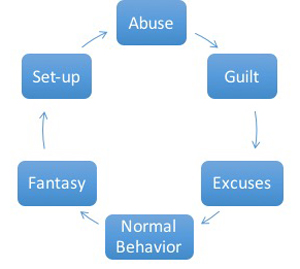
Abuse – Your abusive partner lashes out with aggressive, belittling, or violent beliefs. This handling is a ability play designed to show you "who is boss."
Guilt – Your partner feels guilt later on abusing you, but not because of their deportment. They're more than worried well-nigh the possibility of being caught and facing consequences for their abusive behavior.
Excuses– Your abuser rationalizes what they take washed. The person may come up up with a cord of excuses or blame you for provoking them—anything to avert taking responsibleness.
"Normal" behavior – Your partner does everything in their ability to regain command and ensure that you'll stay in the relationship. A perpetrator may act equally if nothing has happened, or they might "plough on the amuse." This peaceful honeymoon stage may give you promise that the abuser has really inverse this time.
Fantasy and planning – Your abuser begins to daydream about repeating the corruption. They spend a lot of fourth dimension thinking about what you've washed wrong and how they'll make y'all pay for information technology. And then they form a program for turning the fantasy of abuse into reality.
Set up-up – Your abuser sets you up and puts their program in motion, creating a situation where they tin can justify abusing you.
Your abuser's apologies and loving gestures in between the episodes of abuse can make it difficult to leave. They may cause you to believe that you are the just person who can aid them, that they will change their behavior, and that they truly love you. Even so, the dangers of staying are very real.
The full bicycle of domestic violence: An example
A human being abuses his partner. After he hits her, he experiences self-directed guilt. He says, "I'm distressing for hurting you." What he does not say is, "Considering I might go caught."
He then rationalizes his behavior by accusing his partner of having an matter. He tells her, "If you lot weren't such a worthless whore, I wouldn't have to striking you."
He and then acts contrite, reassuring her that it will not happen once again.
But later hefantasizes and reflects on by abuse and decides to injure her again.
He plans on sending her to the grocery shop, purposely choosing a busy fourth dimension. She is then held up in traffic and returns a few minutes later than expected. In his mind, he justifies assaulting her by blaming her for having an affair with the shop clerk. He has just set up her up.
Recognizing the alert signs of abuse
It's impossible to know with certainty what goes on backside airtight doors, but there are some telltale signs of emotional abuse and domestic violence. If you witness these alert signs of abuse in a friend, family unit fellow member, or co-worker, take them very seriously.
People who are being abused may:
- Seem afraid or anxious to please their partner
- Get forth with everything their partner says and does
- Check in often with their partner to report where they are and what they're doing
- Receive frequent, harassing phone calls from their partner
- Talk near their partner'south temper, jealousy, or possessiveness
Alert signs of physical corruption
People who are being physically abused may:
- Have frequent injuries, with the excuse of "accidents."
- Frequently miss work, schoolhouse, or social occasions, without explanation.
- Dress in clothing designed to hide bruises or scars (for example, wearing long sleeves in the summer or sunglasses indoors).
Warning signs of isolation
People who are being isolated by their abuser may:
- Exist restricted from seeing family unit and friends.
- Rarely get out in public without their partner.
- Have limited admission to money, credit cards, or the machine.
Psychological warning signs of abuse
People who are beingness abused may:
- Have very depression self-esteem, even if they used to exist confident.
- Show major personality changes (e.g. an outgoing person becomes withdrawn).
- Exist depressed, anxious, or suicidal.
Speak upwardly if you lot suspect domestic violence or abuse
If you suspect that someone you know is being abused, speak up! If y'all're hesitating—telling yourself that it's none of your business, you might be wrong, or that the person might not want to talk about it—keep in mind that expressing your business organisation will let the person know that you care and may even salve their life.
Talk to the person in private and let them know that yous're concerned. Point out the signs you've noticed that worry yous. Tell the person that you're there for them, whenever they feel ready to talk. Reassure them that you lot'll keep whatever is said between the two of you, and let them know that yous'll help in any manner you can.
[Read: How to Get Out of an Calumniating Relationship]
Remember, abusers are very good at decision-making and manipulating their victims. People who have been emotionally or physically driveling are often depressed, drained, scared, ashamed, and dislocated. They need help getting out of the situation, yet their partner has often isolated them from their family and friends.
By picking up on the warning signs and offering support, you lot tin can aid someone escape an abusive state of affairs and brainstorm healing.
| Exercise'southward and Don'ts | |
| Do: | Don't: |
| Ask if something is wrong | Look for the person to come to you |
| Express your concern | Blame or judge them |
| Listen and validate | Pressure them to deed |
| Offer to assist | Requite advice |
| Support their decisions | Place conditions on your back up |
Source: https://www.helpguide.org/articles/abuse/domestic-violence-and-abuse.htm
0 Response to "In the United States Family Violence Is Quizlet"
Post a Comment